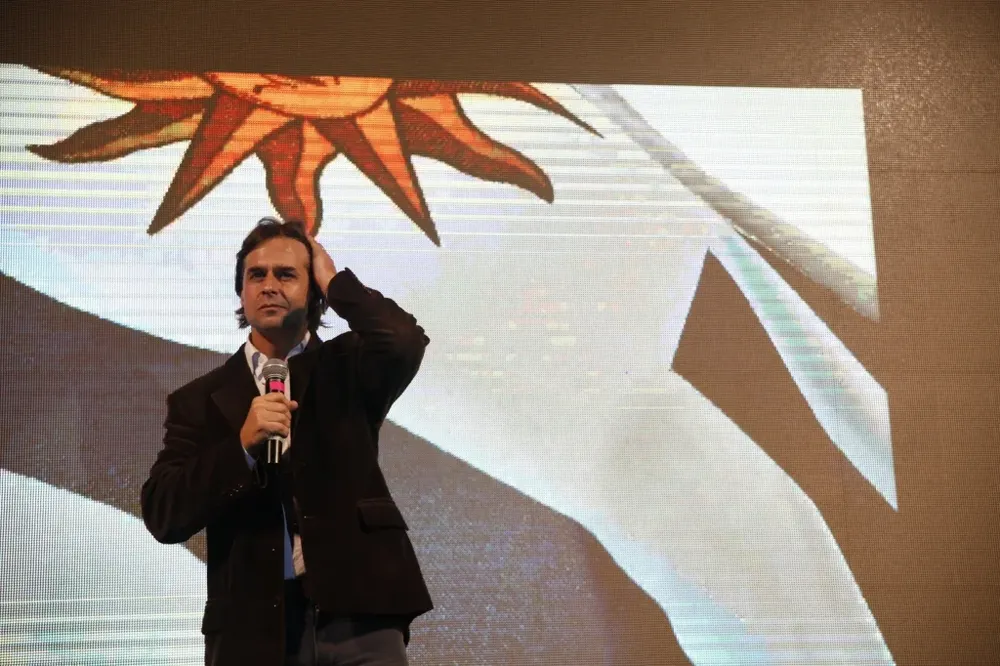
The last-minute guest in the run-up to the elections starting today reshapes the whole scenario. Luis Lacalle Pou's campaign, which climbed from the 6% within the Partido Nacional up to a leading 55%, changes the strategies of both Frente Amplio and Partido Colorado. The growth of this phenomenon has been making waves. Where will this wave carrying the surfer reach? It will certainly depend on the internal aspects of his party and on decisions made by Jorge Larrañaga in the next hours.
Contrary to what it seemed some time ago, the competition is open and not only in terms of parliamentary majority. The Presidency is in play and so Frente Amplio members are taking action.
Another relevant aspect of this internal election, which affected all the parties, is the low level of participation. The number of voters was significantly lower regarding previous elections. Only a 39% approximately of those authorized to vote went to the polls. The lowest percentage in internal elections had been in 2009, when only a 45% of authorized voters voted.
Lacalle Pou, as well as the former president Tabaré Vázquez and Pedro Bordaberry will move towards the political centre.
It is easier for the new leader of Partido Nacional. He seemed skeptical, unattached to an ideology. But he will definitely receive some darts from the left for his surname and “neoliberal” label. He already tried to immunize against but this is not over yet.
Vázquez had to rush the shift towards that centre some weeks ago when he nominated Danilo Astori for the Ministry of Economy. Moreover, yesterday he presented a pack of measures that seeks to cope with those matters addressed by the opposition on their campaigns: education, security and housing.
On his attempt to become the leader of the opposition, Bordaberry will have to face the challenge of competing against a rival who has a profile that is more similar to his. Therefore, Lacalle Pou's victory forces him to polish his strategy. May he capture some votes from Larrañaga? That is another question yet to be answered.
The victory of the new leader of Partido Nacional also discredited a preconception of most political experts that electoral campaigns necessarily imply confrontation.
His motto “Por la Positiva” goes against that way of facing politics. Moreover, he intends to dismiss the idea that with his victory the country would once again become polarized between left and right. “We don´t want a divided country,” he said yesterday in one of his speeches.
The Run-Up That Matters
By the start of the campaign, there was something all analysts and pollsters agreed on: Vázquez was the favourite to be elected president for the second time and it was the parliamentary majority what was yet to be defined.
Throughout the course of the campaign this scenario changed. The parliamentary majority is increasingly further for Frente Amplio.
So far, according to Cifra´s director Luis Eduardo González, “everything is in dispute”.
“To this date, Vázquez is still the favourite candidate. But surveys show yesterday´s results. Considering these results, I am not sure about what will the opinion say tomorrow. If it was clear before, now it is reasonably clear that parliamentary majorities…are not. Now it may also seem clear, that is it is perfectly possible, that today everything is in dispute,” González stated in Canal 12.
The results of yesterday´s election -in which Partido National obtained the 41% of votes, Frente Amplio the 34% and Partido Colorado the 14%- are not significant.
Indeed, it only evidences that Partido Nacional, by means of its competitive internal rivalry, was able to bring together the largest number of supporters. But such data is not applicable for October.
Other may understand that FA kept on losing votes. There is an estimate of 50 thousand less votes regarding 2009 elections. Still, in such elections the FA there was more competitive internal rivalry between José Mujica and Astori.
The Wave
Last night, in Frente Amplio, some leaders were analysing that the voting result of Partido National was the worst case scenario. Vázquez had picked Larrañaga as his rival months ago.
“I was surprised by Lacalle Pou winning. I really thought Larrañaga would win. Now starts the real run-up for Frente Amplio,” Lucía Topolansky, the first senator of the left, stated.
Some of FA leaders interviewed by El Observador are afraid that Lacalle Pou has become popular as the current president José Mujica did. “Lacalle Pou grows as foam and no one knows where it ends,” some of the leaders mentioned last night.
The new leader of the National Party will have to solve a hard internal problem. He does not know if he will count on Larrañaga. He did not want his as candidate to vice-president (Carlos Moreira is the most promising option). Nevertheless, it is important to show a party that is as unite as possible.
Even if Larrañaga steps down, the rest of his sector will side with Lacalle Pou as he needs it.
Vázquez´s Change
Former president Vázquez had already revealed in the morning when he went to the polls that at night he would make announcements. And he made them towards the centre. But beyond his proposals and what he said, his gestures were actually relevant.
Vázquez stood as president rather than as a candidate to such position. He left behind that mocking tone he had used to refer to his rivals to express his respect to the candidates from both Partido Nacional and Partido Colorado.
In the internal run-up he had picked Larrañaga as his rival and he never criticized Lacalle Pou.
Bordaberry And The Contrast
Bordaberry will try to reach the second position of voters preferences to secure a place in the second ballot. For such purposes, his main battle facing October is against Lacalle Pou.
Although both of them try to appear as unattached to ideologies, many of their voters identify themselves as right.Therefore, in some way they both gather the same group of citizens.
Yesterday, he already started to intend to stand out differently, as the man who can add “experience” to “renovation”.